
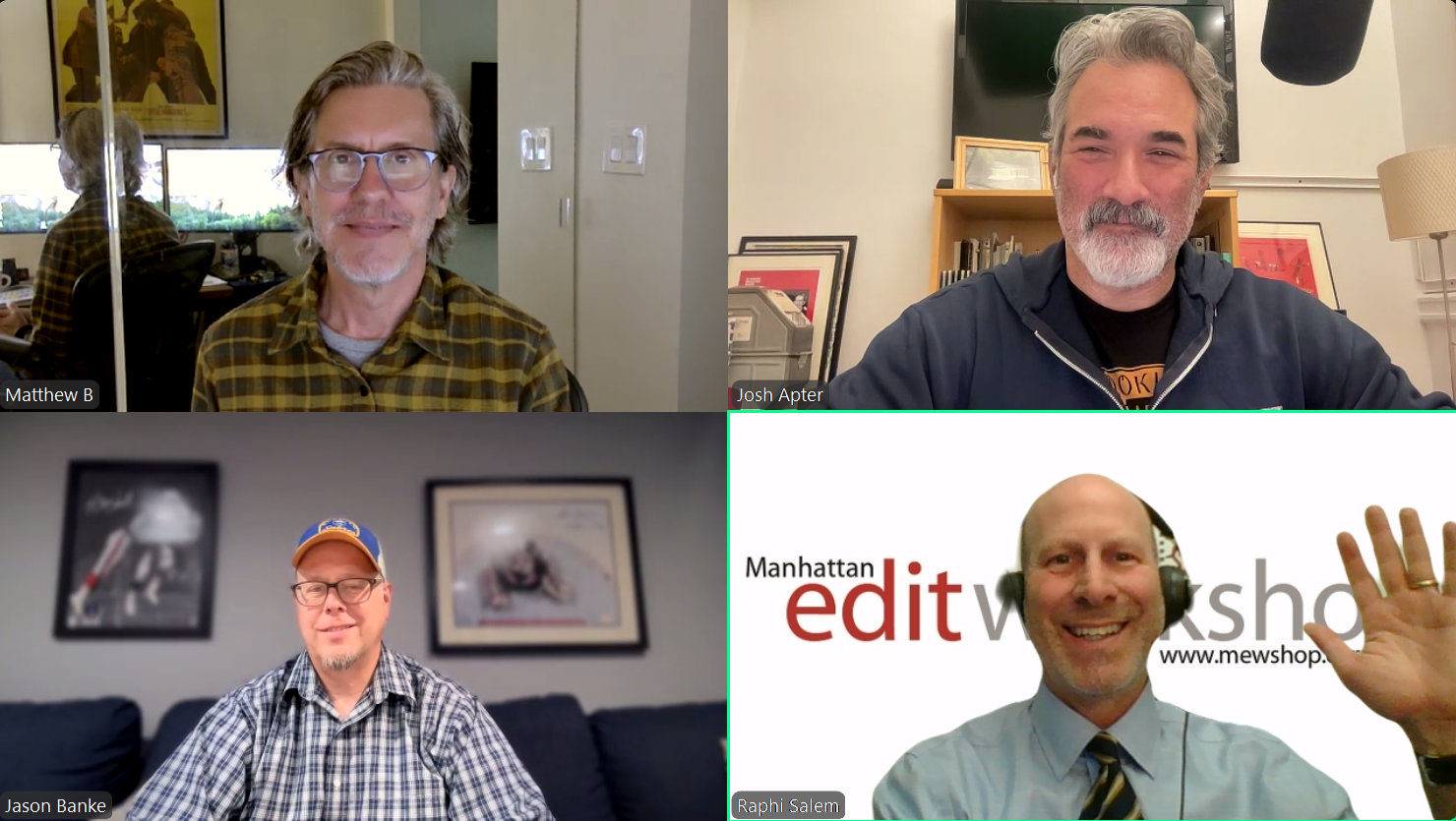
This is an article based on an episode of Manhattan Edit Workshop’s “Talking MEWShop.” You can watch the conversation by following or subscribing to the show HERE.
In the early 1990s, before LinkedIn portfolios and Vimeo links, breaking into film and television post-production involved a kind of leap-of-faith persistence that now feels almost mythological. For editor Matthew Barbato, that leap began with a printed directory, a stack of paper résumés, and a willingness to mail them—one by one — to production companies that might not even exist anymore.
“I sent out 210 resumes,” he recalled. “Within a week, half of them came back ‘undeliverable.’ That was my first lesson about this industry.”
One of those résumés, however, reached its destination. It earned him an interview at a small New York company with three producers and a single editor — a job answering phones. It wasn’t glamorous. But it put him in the room. And when the company adopted its first nonlinear system — predating Avid — they asked whether he wanted to assist the editor.
He didn’t hesitate. “Anything was better than phones,” he said.
That first “yes” became the beginning of a chain reaction, threading through several eras of a changing industry: the cable documentary boom, the first wave of unscripted hybrid storytelling, the content surge after the 2008 writers’ strike, and finally the streaming renaissance of prestige comedy and literary adaptation.
Each cycle wasn’t just a shift in technology or style — it was a doorway.
The Unscripted Years
For years, Matthew built his craft in nonfiction and unscripted television: Discovery, TLC, early reality formats, docu-series with limited budgets but sprawling volumes of footage. He became what producers then called a “preditor”—a dual producer-editor who could both build a story and shape performance in the same seat.
Yet his ambition was always pointed toward scripted television. What blocked him wasn’t skill, but perception.
“There used to be a stigma,” he said. “People assumed if you came from documentary, you didn’t know how to handle narrative performance — or they didn’t know whether the work on your reel was actually yours.”
Editors are among the least visible creative roles in television. Unlike a cinematographer, whose style can be instantly read through an image, an editor’s authorship is often invisible by design. That made gatekeeping easier.
So he did what many do when the geography of opportunity shifts: he moved to Los Angeles.
And then he started over.
The Crack in the Door
The breakthrough didn’t come from a studio or an agent — it came from a friend producing a small comedy series for Adult Swim. He was invited, almost casually, to edit one episode of Children’s Hospital. It was meant to be temporary, even experimental.
It turned into a calling card.
More episodes followed: NTSF:SD:SUV, Newsreaders, later Wet Hot American Summer. The timing was once again synchronous. The strike-era comedy boom — fueled by online sketch collectives, UCB improvisers, and cable networks hungry for cheap but fast storytelling — suddenly valued something unscripted editors had mastered:
They knew how to build rhythm without a script dictating it.
“They realized you could take pieces from different takes, different lines, and make something feel alive,” he said. “The improvisational nature of those shows needed editors who were comfortable shaping story from material instead of defending the page.”
It was, unexpectedly, the bridge to prestige work.
The Streaming Era
His move into longform scripted arrived through the swell of streaming investment. He joined Lessons in Chemistry early in its creative life, helping shape one of its most emotionally seismic turns — the twist at the end of Episode 2 — a moment that redefines the series and threads grief through its optimism.
The work, he explains, was less about shock than calibration.
“In nonfiction, you’re sculpting from something that happened once,” he said. “In scripted, you have four or five emotional versions of a moment. You’re deciding not just what is correct — but what is right for this place in the character’s timeline.”
From there came the opportunity he didn’t expect: returning to a show years after launching it. He cut Season 1 of Only Murders in the Building, left for a feature, and could not return for Seasons 2 and 3 due to schedule conflicts. But in Season 4, timing opened a door almost unheard of in the modern TV calendar: coming home to a show long after its tone had fully matured.
“It’s rare,” he said. “Streaming schedules overlap so aggressively that editors almost never get to return. But it’s a joy when you can — especially with a cast that can pivot from farce to heartbreak inside the same frame.”
On AI and the Landscape Ahead
Matthew is measured but candid on AI. He experimented, cautiously, with voice replication for temporary ADR — and then pulled away from it entirely.
“I was always clear: it was only for temp,” he said. “But that line is too easy to blur. It’s not where I believe the technology should live.”
Still, he believes there are places AI could help editors — not in performance, not in narrative shaping — but in the machinery of workflow. Efficiency tools, not authorship replacements.
“I probably shouldn’t say what I think the best use cases are,” he said, with a half-smile, “because I might still build one of them.”
The Larger Thread
What his trajectory illustrates — quietly but unmistakably — is that editing careers are not linear. They are tide-based. Each opening comes when the industry runs out of people who already fit the mold — and needs editors shaped by a different muscle.
Asked what advice he gives young editors today, he doesn’t romanticize it.
“If you know you want scripted, get there early. You get pulled upward inside the lane you start in. Switching lanes is not impossible — but it is uphill.”
His own career was built across booms: cable, then digital comedy, then streaming. Now the tide is receding — and someday, inevitably, it will surge again.
The editors who are ready when the next door opens will likely look a lot like he once did: skilled, overlooked, persistent — and waiting for the one résumé that doesn’t come back marked “undeliverable.”